
A good custard is judged by texture before flavour. It should pour in a slow ribbon, coat the back of a spoon, and feel completely smooth on the tongue. Lumps are not a sign that you lack some rare talent in the kitchen. They come from one of three things: eggs heated too quickly, a pan that is too hot, or a whisk that stopped moving for a few seconds too long. Fix those three and homemade custard becomes one of the easiest desserts you can make.
Why Custard Turns Lumpy
Egg yolks thicken liquid because their proteins unwind and link together as they get warm. That linking starts somewhere around 71°C (160°F) and does its best work between 77°C and 82°C (170–180°F). Push past that and the proteins tighten, squeeze out water, and turn grainy — the same thing that happens to scrambled eggs left too long in a pan.
Whole eggs are a bigger risk than yolks alone, because egg whites set at a slightly lower temperature and set firmly. Sugar and starch both buy you a margin: sugar dissolves into the yolks and raises the temperature at which they begin to set, while a spoonful of cornstarch physically gets in the way of protein strands joining. That is why a custard with a little starch forgives a distracted cook far more readily than a pure egg-and-cream mixture.
What You Need Before You Start
Nothing here is specialist equipment, but the right pan and a sieve matter more than you would think.
- Dairy: 480 ml (2 cups) whole milk, or half milk and half cream for a richer set. Skim milk is more likely to catch and curdle.
- Eggs: 4 to 5 large yolks for a classic pouring custard, or 3 yolks plus 1 whole egg for a firmer one.
- Sugar: 65–75 g (about ⅓ cup), whisked into the yolks.
- Optional thickener: 1 tablespoon cornstarch, for insurance.
- Flavour: a pinch of salt and a teaspoon of vanilla extract or the seeds of half a vanilla pod.
- Equipment: a heavy-bottomed saucepan, a balloon whisk, a heatproof bowl, a fine-mesh sieve, and a silicone spatula. An instant-read thermometer helps but is not essential.
A thin pan with a warped base will give you hot spots, and hot spots are where custard scrambles. If yours is lightweight, keep the heat lower and stir more.
Tempering: The Step Most People Rush
Tempering means raising the temperature of the eggs gradually so they never meet heat they cannot handle. The technique is simple, but the order matters.
- Whisk the yolks, sugar, salt and cornstarch (if using) in a bowl until pale and slightly thickened, about a minute.
- Heat the dairy in the saucepan over medium-low until it steams and small bubbles ring the edge. Do not let it boil.
- Ladle two or three tablespoons of the hot dairy into the yolks, whisking the whole time. Whisk the bowl, not the saucepan — the point is to move the eggs constantly as the hot liquid goes in.
- Add another ladle, then another, until roughly half the dairy is in the bowl and the mixture feels warm to the touch.
- Pour everything back into the saucepan with the remaining dairy, whisking as you go.
If you spot pale flecks of cooked egg at any point, you poured too fast or stopped whisking. Strain the mixture into a clean bowl, then return it to the pan and carry on a little more slowly. Nothing is ruined yet.
Gentle Heat and Constant Motion
Set the pan over medium-low heat and stir without stopping. A whisk works, but a silicone spatula is better because it scrapes the base and the corners where custard likes to sit and set. Move in figure eights across the bottom, then sweep around the edge. If you can feel the mixture thickening under the spatula before you see it, you are doing it right.
Expect five to ten minutes. The custard is ready when it coats the back of a spoon and a finger drawn through the coating leaves a clean line that holds. If you have a thermometer, aim for 77–82°C (170–180°F) and pull the pan off the heat the moment you get there.
Signs you have gone too far
Steam rising hard, bubbles breaking the surface, or a grainy texture at the edge of the pan all mean the eggs are setting too fast. Take the pan off the heat immediately, keep stirring, and sit the base in a bowl of cold water to stop the cooking. Strain the custard and taste it — a slightly grainy batch usually smooths out and is perfectly good for pouring.
Strain It, Even If It Looks Smooth
Pour the finished custard through a fine-mesh sieve into a clean bowl, pressing it through with the back of a ladle. Even a custard that looks flawless can carry tiny strands of cooked egg, bits of chalaza, or a skin that formed on the surface. Thirty seconds with a sieve turns a good custard into a glossy one, and it catches the lumps you did not know were there. Stir in the vanilla after straining, not before, so you keep the flavour bright.
If It Has Already Gone Lumpy
Straining is the first fix, and it solves most mild cases. For a seriously lumpy batch, give it a short, low blitz with an immersion blender, then strain again. The texture will be a touch thinner, which makes it ideal as a sauce rather than a set dessert. If the custard has curdled into something resembling sweet scrambled eggs, strain it and either use the smooth portion as a sauce or start again — no amount of extra whisking will reverse it.
Chilling, Serving and Storing
Press a sheet of plastic wrap directly onto the surface of the custard while it is still warm; this prevents a skin forming. Let it cool, then refrigerate. It will keep for three to four days and thickens slightly as it chills, so stir it before serving and loosen it with a spoonful of milk if you want it pourable.
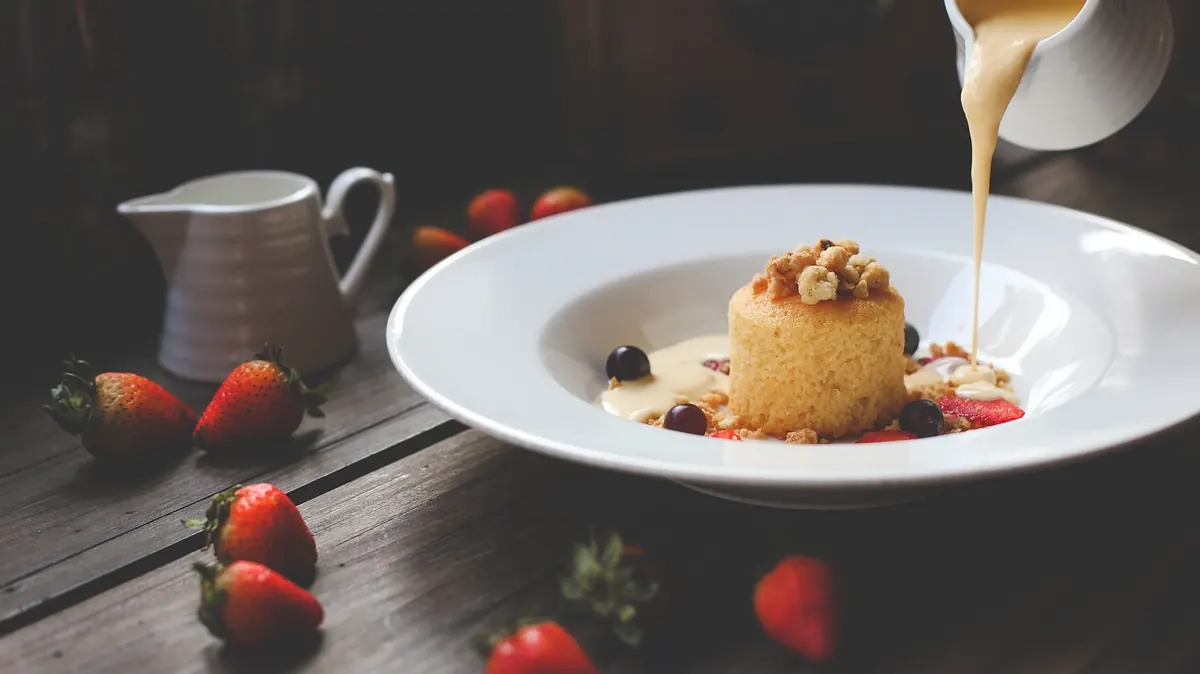
Serve it cold with fruit crumble, sponge pudding, or a bowl of berries, or warm it gently over low heat for a pouring sauce. Because it contains eggs and dairy, refrigerate it within two hours of making it and throw it out if it smells or looks off — reheating a suspect custard will not make it safe. If you are cooking for someone with an egg allergy or another dietary restriction, take advice from a qualified health professional about suitable substitutions rather than guessing.
Photo: StockSnap / Pixabay